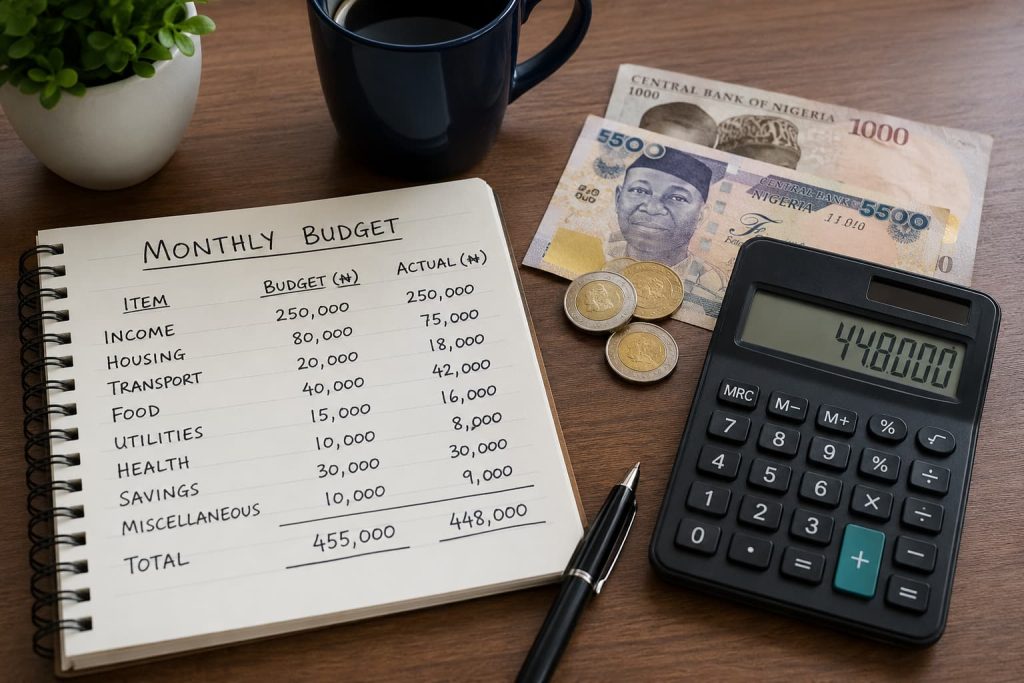
A budget can look perfect on paper and still fail before the month is over. Budgeting in Nigeria can be especially challenging when you are trying to plan for food, transportation, rent, savings, family responsibilities and personal spending while prices keep changing.
One unexpected bill, a financial request from family, or a series of small expenses can quickly disrupt even a carefully planned budget. The solution is not simply to write down your income and expenses—it is to create a realistic budget that works with the realities of everyday life in Nigeria.
That is why budgeting in Nigeria should not be about copying a percentage rule from the internet and forcing your life to fit it.
A useful budget is a financial plan built around your actual income, expenses, obligations and goals. It tells your money where to go before it disappears—and gives you a way to adjust when circumstances change.
This is particularly important when your income or expenses are unpredictable. Nigeria’s economic environment can make fixed assumptions about monthly spending unreliable. The National Bureau of Statistics (NBS), for example, regularly publishes updated consumer-price data, illustrating why a budget should be reviewed rather than treated as a permanent document.
The Central Bank of Nigeria (CBN) also identifies financial literacy and budgeting as important parts of helping individuals manage financial resources effectively, prioritize spending and cope with irregular income.
The goal, therefore, is not to create a beautiful spreadsheet.
The goal is to create a budget you can actually live with, monitor and adjust.
Are financial limitations holding you back?
Take your concerns to God through 7 Keys to Breaking Financial Limitations — 7 Midnight Prayers, a focused prayer resource designed to guide you through seven nights of intentional prayer.
Get the 7 Keys to Breaking Financial Limitations
What Is a Budget?
A budget is a plan for how you will allocate your available money over a specific period, usually a month.
At its simplest:
Income − Planned Expenses − Savings/Debt Goals = Remaining Money
But a practical budget does more than subtract expenses from income.
It helps you answer questions such as:
• How much money can I safely spend?
• How much should go toward food and transportation?
• Can I afford this purchase?
• How much can I save this month?
• How much should I reserve for irregular expenses?
• Can I support a family member without damaging my own finances?
• How much can I put toward debt?
• What happens if my income falls next month?
• Am I spending more than I realize on small purchases?
A budget is therefore both a planning tool and a decision-making system.
It is not a punishment for spending money.
You create a budget precisely so you can spend money with greater confidence.
Why Budgeting Matters in Nigeria
Budgeting matters everywhere, but the realities of Nigerian households can make it especially useful.
A person’s financial life may include salary, business income, freelance work, side hustles, family obligations, transportation costs, rent, school fees, medical expenses, data subscriptions, electricity, food and debt payments—all competing for the same naira.
Some expenses are also not monthly.
Rent may be paid annually. School fees may arrive once or twice a year. Insurance may be annual. Repairs may happen unexpectedly. Family ceremonies may create occasional expenses.
If you only think about what you spend this month, you can easily underestimate what your money needs to cover over the entire year.
A budget helps you do five important things:
1. Know where your money is going
2. Separate needs from discretionary spending
3. Prepare for irregular expenses
4. Protect savings and financial goals
5. Make better decisions when income or prices change
The CBN’s financial-literacy framework specifically highlights the importance of having a personal financial plan encapsulated in a budget, adhering to it and prioritizing spending according to pressing needs rather than wants.
That distinction is crucial.
A budget should not simply record what you already do.
It should help you decide what you should do with your money next.
Step 1: Calculate Your Real Monthly Income
Before creating spending limits, determine how much money is actually available.
If you earn a fixed salary, this is relatively straightforward.
Suppose your monthly take-home income is:
₦300,000
If you also earn money from freelance work, business activities or a side hustle, don’t automatically treat your highest recent income as guaranteed.
Instead, estimate your reliable income.
For example:
| Income source | Amount |
| Salary | ₦300,000 |
| Freelance income | ₦50,000 |
| Side business | ₦30,000 |
| Total expected income | ₦380,000 |
If the ₦50,000 freelance income is inconsistent, however, your budget should not depend on receiving it every month.
You could build your core budget around ₦300,000 and treat additional income as variable money allocated according to your priorities.
Why this matters
One of the easiest budgeting mistakes is spending expected income before it arrives.
For example:
“I should make about ₦80,000 from my side business this month, so I’ll use it to cover the extra expenses.”
What happens if the business generates ₦35,000 instead?
You have already committed money that never arrived.
A better rule
Build essential commitments around reliable income and treat uncertain income conservatively.
This is especially useful for:
• freelancers
• traders
• business owners
• commission-based workers
• contractors
• casual workers
• people with multiple income sources
Step 2: Find Out Where Your Money Is Actually Going
You cannot build a realistic budget from memory.
For at least one month, record your spending.
Ideally, review several months because some expenses occur infrequently. The Consumer Financial Protection Bureau similarly recommends reviewing actual spending and accounting for less frequent expenses such as medical costs, education, support for family members, gifts and other irregular expenses.
You can use:
• a notebook
• spreadsheet
• budgeting app
• bank transaction history
• mobile banking records
• receipts
• phone notes
The method matters less than consistency.
Record even small expenses.
For example:
• ₦1,000 for breakfast
• ₦800 for transportation
• ₦500 for airtime
• ₦2,000 for lunch
• ₦1,500 for a subscription
• ₦3,000 for an unplanned purchase
A ₦1,000 expense may appear insignificant.
But ten such expenses are ₦10,000.
That is why expense tracking is the diagnostic stage of budgeting.
Before trying to control spending, understand it.
Step 3: Divide Expenses Into Useful Categories
A simple way to organize expenses is to separate them into four groups.
3.1. Fixed expenses
These are expenses that are relatively predictable.
Examples include:
• rent allocation
• school fees allocation
• loan repayment
• insurance
• subscription commitments
• regular support obligations
Some fixed expenses are not paid monthly, but you can convert them into a monthly budget amount.
For example, if an annual expense is ₦240,000:
₦240,000 ÷ 12 = ₦20,000 per month
You could therefore set aside ₦20,000 each month rather than waiting until the bill arrives.
3.2. Variable essential expenses
These are necessary expenses whose amounts change.
Examples:
• food
• transportation
• electricity
• water
• healthcare
• household supplies
• data and communication
These require monitoring because the amount can change from month to month.
3.3. Discretionary expenses
These are purchases that improve your lifestyle but are generally not essential.
Examples:
• entertainment
• restaurant meals
• impulse purchases
• non-essential shopping
• leisure activities
• upgrades
• some subscriptions
Discretionary spending is not automatically bad.
The problem is spending on wants without first accounting for needs and financial goals.
3.4. Financial goals
These are amounts allocated toward improving your future financial position.
Examples:
• emergency savings
• debt repayment above the minimum
• investing
• business capital
• education
• house deposit
• retirement
• a major purchase
This category is important because saving should not simply be whatever happens to remain at the end of the month.
If you wait for leftover money, there may be nothing left.
Step 4: Separate Needs From Wants
This is one of the most important budgeting skills.
A need is something that is necessary for your basic responsibilities or wellbeing.
A want is something desirable but potentially postponable, reduced or eliminated.
The distinction is not always absolute.
For example:
Internet/data
• For someone working remotely: potentially essential.
• For someone using it mainly for entertainment: partly discretionary.
Transportation
• Transport to work: essential.
• Frequent ride-hailing when cheaper options are practical: potentially discretionary.
Phone
• Basic communication: essential.
• Buying the latest premium phone when your current device works: discretionary.
The objective is not to eliminate every want.
It is to make sure your wants do not silently consume money needed for your priorities.
A useful question before spending
Ask:
“If I don’t buy this now, what happens?”
If the answer is “nothing important,” you may have identified a discretionary expense.
Step 5: Budget for Savings Before the Month Begins
Saving should be treated as an expense in your financial plan—not as an afterthought.
Suppose you earn ₦250,000 and decide that your initial savings target is ₦25,000.
Instead of:
Income → spending → whatever remains becomes savings
use:
Income → savings allocation → essential expenses → discretionary spending
This creates a stronger system.
However, don’t blindly adopt a particular savings percentage simply because it is popular online.
Someone earning ₦150,000 with substantial rent and family responsibilities may have a completely different realistic savings capacity from someone earning ₦800,000 with low fixed expenses.
The correct savings amount is the amount that is:
• meaningful
• sustainable
• consistent with your obligations
• compatible with your financial goals
If you can only save a small amount initially, start there and improve the amount as your financial situation improves.
Step 6: Build an Emergency Fund Into the Budget
An emergency fund is money reserved for genuine unexpected financial needs.
Examples include:
• unexpected medical expenses
• urgent repairs
• sudden loss of income
• essential transportation problems
• emergency family situations
It should not normally be used for:
• routine shopping
• entertainment
• planned vacations
• impulse purchases
• predictable annual expenses
The Consumer Financial Protection Bureau describes emergency savings as money set aside specifically for unplanned expenses or financial emergencies and notes that even small amounts can provide some financial protection.
Start with a smaller target if necessary
You don’t have to begin by trying to save a huge amount.
If your current income is limited, your first goal could simply be:
₦20,000 → ₦50,000 → ₦100,000 → larger reserve
The exact target should depend on your circumstances.
Eventually, you may want a reserve capable of covering several months of essential expenses, particularly if your income is unstable.
The important principle is:
An effective emergency fund strategy gives you a financial cushion when unexpected expenses, emergencies, or income disruptions occur. Learn how to build an emergency fund, determine how much to save, and protect your budget and financial goals from unexpected financial setbacks.
Step 7: Budget for Expenses That Don’t Happen Every Month
This is where many Nigerian budgets fail.
Imagine someone earns ₦400,000 every month.
Their normal monthly expenses appear manageable.
But then:
• annual rent is due
• school fees arrive
• insurance renewal is due
• a family event occurs
• a vehicle needs repairs
Suddenly, the budget appears “broken.”
The problem may not be the monthly income.
The problem is that irregular expenses were never included in the plan.
Create sinking funds
A sinking fund is money gradually set aside for a known future expense.
Suppose you expect:
| Future Expense | Estimated Annual Amount |
| School-related expenses | ₦240,000 |
| Insurance | ₦120,000 |
| Annual maintenance | ₦120,000 |
| Total | ₦480,000 |
Monthly allocation:
₦480,000 ÷ 12 = ₦40,000
Instead of finding ₦480,000 when the bills arrive, you gradually prepare for them.
This is one of the most powerful ways to make a budget more realistic.
Step 8: Create a Budget That Reflects Your Actual Life
Now combine your income and expenses.
Consider this hypothetical example.
A person earns ₦350,000 monthly.
Their initial budget might look like this:
| Category | Planned Amount |
| Food | ₦75,000 |
| Transportation | ₦35,000 |
| Utilities | ₦25,000 |
| Rent provision | ₦50,000 |
| Family responsibilities | ₦30,000 |
| Data/communication | ₦10,000 |
| Emergency savings | ₦25,000 |
| Long-term savings/investing | ₦30,000 |
| Personal/discretionary | ₦20,000 |
| Irregular-expense fund | ₦30,000 |
| Total | ₦330,000 |
| Unallocated buffer | ₦20,000 |
Notice something important.
The entire ₦350,000 was not immediately assigned to ordinary consumption.
There is a ₦20,000 buffer.
That buffer can absorb small variations without destroying the entire budget.
Why a buffer matters
Real life does not follow spreadsheets.
A transport cost can increase.
A household item may need replacing.
A medical expense may arise.
A business opportunity may require a small payment.
A budget with no flexibility can become frustrating because one unexpected expense causes multiple categories to fail.
A modest buffer makes the system more resilient.
Should You Follow the 50/30/20 Budget Rule?
You may have heard of the 50/30/20 rule, which broadly divides income into needs, wants and savings/debt goals.
It can be useful as a starting framework.
But it should not be treated as a law.
For someone facing:
- high housing costs
- substantial family responsibilities
- expensive transportation
- significant debt
- irregular income
- low income
a rigid percentage allocation may be unrealistic.
A person earning ₦200,000 cannot necessarily force their finances into the same proportions as someone earning ₦1 million.
Use percentages as diagnostic tools, not commandments.
If essential expenses consume 80% of your income, the solution may not be:
“I must somehow reduce essentials to 50%.”
The more useful question is:
“Which expenses are driving the pressure, and what can realistically change?”
The answer could involve:
- reducing housing costs
- changing transportation arrangements
- restructuring debt
- increasing income
- reducing discretionary spending
- finding cheaper alternatives
- sharing certain household costs
- planning irregular expenses
A good budget responds to reality.
How to Budget When Your Income Is Low
Budgeting on a low income requires a different mindset.
If most of your income already goes toward basic necessities, the problem may not be poor discipline.
There may simply not be enough money.
That distinction matters.
Suppose someone earns ₦120,000 and spends:
- ₦50,000 on food
- ₦25,000 on transportation
- ₦20,000 on housing contribution
- ₦10,000 on utilities
- ₦10,000 on healthcare/essential needs
- ₦5,000 on other essentials
That is already ₦120,000.
Telling this person to “stop buying unnecessary things” may not solve the underlying problem.
The strategy should have two sides:
1. Control avoidable expenses
Look for realistic reductions in:
- food waste
- unnecessary transport
- subscriptions
- impulse purchases
- expensive convenience spending
- avoidable bank charges
2. Increase earning capacity
Consider:
- freelance services
- small business activities
- professional skills
- additional shifts
- consulting
- digital services
- selling products
- monetizing existing skills
When the margin is extremely small, income growth can be just as important as expense reduction.
How to Budget With Irregular Income
Irregular income requires a different approach from salary budgeting.
Suppose a freelancer earns:
- January: ₦250,000
- February: ₦400,000
- March: ₦180,000
- April: ₦500,000
Using ₦500,000 as the normal monthly budget would be dangerous.
Instead, calculate a conservative baseline based on your actual income history and essential expenses.
You can also divide irregular income into two layers:
Layer 1: Core living budget
Money needed for:
- food
- housing
- transportation
- utilities
- healthcare
- essential obligations
Layer 2: Variable income allocation
Additional money can then be directed toward:
- emergency reserves
- taxes where applicable
- business reinvestment
- debt reduction
- long-term savings
- investing
- discretionary spending
This creates greater stability.
Another useful technique: create an income buffer
During strong income months, avoid immediately upgrading your lifestyle.
Instead, retain some of the excess.
That money can support your core budget during weaker months.
This is effectively a personal cash-flow stabilization system.
How to Budget for Family Responsibilities
Family obligations are an important part of many Nigerian households.
A budget that ignores them may look mathematically attractive but fail in real life.
If you regularly support:
- parents
- children
- siblings
- relatives
- dependants
include the support as a planned category.
For example:
Family support: ₦30,000 monthly
is easier to manage than repeatedly sending unpredictable amounts until your account balance becomes dangerously low.
But there is an important boundary:
Helping others should not automatically mean destroying your own financial stability.
If you consistently give away money needed for:
- food
- rent
- debt repayment
- emergency savings
- essential healthcare
you may be creating a financial problem that eventually affects both you and the people who depend on you.
A budget gives you a way to establish a sustainable amount.
How to Handle Rising Prices
A budget is not a contract with the economy.
If the price of food, transport or utilities changes significantly, your old budget may stop working.
For example, suppose you originally allocated:
₦50,000 for food
but your actual spending repeatedly reaches:
₦65,000
There are three possible explanations:
1. You are overspending.
2. Your original estimate was unrealistic.
3. Prices or household circumstances have changed.
Do not automatically assume the first explanation.
Nigeria’s official statistics are periodically updated because prices and economic conditions change. NBS has also rebased its Consumer Price Index, reinforcing the importance of using current official data when making claims about inflation rather than relying on outdated figures.
When prices increase, review the budget in this order:
First: protect essential needs.
Second: reduce or postpone discretionary spending.
Third: look for cheaper substitutes.
Fourth: review savings targets temporarily if necessary.
Fifth: consider ways to increase income.
Do not simply pretend that the old numbers still work.
A Better Way to Control Food Spending
Food is often one of the largest variable expenses in a household budget.
Instead of setting an arbitrary number, look at actual consumption.
For example, calculate:
Weekly food spending × 4.33 = approximate monthly food spending
If you spend ₦18,000 per week:
₦18,000 × 4.33 = ₦77,940
That gives you a more realistic monthly estimate than simply choosing ₦60,000 because it “sounds reasonable.”
You can then investigate the actual drivers:
- market purchases
- eating outside
- snacks
- delivery
- drinks
- food waste
- convenience purchases
The objective is not necessarily to eat less.
It is to understand where the money is going and determine which spending provides enough value to justify its cost.
Budgeting for Transportation
Transportation deserves its own category because it can quietly become expensive.
Track:
- work transportation
- school transportation
- business trips
- ride-hailing
- fuel
- vehicle maintenance
- occasional long-distance trips
If you own a vehicle, fuel is not the entire transportation cost.
You should also consider:
- servicing
- tyres
- repairs
- insurance
- registration-related expenses where applicable
This is another reason to maintain an irregular-expense fund.
A vehicle repair may not happen every month, but that doesn’t make it financially irrelevant.
Budgeting for Debt
If you have debt, include required repayments in your budget before allocating money to optional spending.
A useful debt section should show:
| Debt | Monthly payment | Balance | Interest/charges |
| Loan A | ₦30,000 | ₦300,000 | Check terms |
| Loan B | ₦20,000 | ₦150,000 | Check terms |
Always use the actual terms of your loan or credit agreement.
After covering required payments, additional debt repayment can become one of your financial priorities, especially where the debt carries significant costs.
Avoid taking new loans simply to maintain a lifestyle that your current income cannot support.
Give Every Naira a Job—But Don’t Make the Budget Too Rigid
A useful concept in budgeting is zero-based budgeting.
This means assigning your available income to planned categories until:
Income − planned allocations = ₦0
That does not mean you literally spend every naira.
It means every naira has a planned purpose.
For example:
- ₦30,000 → emergency fund
- ₦30,000 → investing
- ₦50,000 → rent provision
- ₦75,000 → food
- ₦35,000 → transportation
- ₦25,000 → utilities
- ₦30,000 → family support
- ₦20,000 → personal spending
- ₦35,000 → irregular expenses
- ₦20,000 → buffer
The key is that money isn’t “unassigned.”
An unassigned balance can easily become accidental spending.
What to Do When You Overspend
Overspending does not mean your budgeting system has failed permanently.
Instead, investigate it.
Suppose your food budget is ₦60,000 but you spend ₦72,000.
Don’t simply write:
“I failed.”
Ask:
• What caused the extra ₦12,000?
• Was there a special event?
• Did food prices change?
• Did I eat out more?
• Did I buy unnecessary items?
• Was the original budget unrealistic?
Then decide whether the next month requires:
• a lower discretionary category
• a higher food allocation
• better meal planning
• a different shopping strategy
• additional income
• a temporary adjustment elsewhere
Budget review is more useful than budget guilt.
Common Budgeting Mistakes to Avoid
Learn the most common budgeting errors to avoid and practical ways to create a realistic budget that helps you control spending, save consistently, and manage your money wisely.
1. Creating a budget from imagination
You cannot know your real spending without tracking it.
Fix: Use actual bank records, receipts and spending history.
2. Making the budget unrealistically strict
A budget that leaves no room for normal human behavior may not survive.
Fix: Include reasonable personal spending and a small buffer.
3. Forgetting irregular expenses
Annual and occasional bills eventually arrive.
Fix: Convert predictable annual expenses into monthly sinking-fund contributions.
4. Treating savings as leftover money
If you wait until the end of the month, spending may consume everything.
Fix: Include savings in the initial allocation.
5. Copying someone else’s percentages
A percentage that works for another household may not work for yours.
Fix: Build around your actual income, obligations and goals.
6. Ignoring irregular income
Budgeting around your best month can create serious cash-flow problems.
Fix: Build essential spending around conservative, reliable income.
7. Failing to adjust the budget
Prices and circumstances change.
Fix: Review your budget regularly.
8. Tracking expenses but never changing behavior
Recording spending is only useful if the information influences decisions.
Fix: Identify the two or three categories causing the greatest financial pressure.
9. Treating every unexpected expense as an emergency
Some expenses are unexpected but predictable over time.
For example, vehicle maintenance is not necessarily a financial emergency simply because you don’t know the exact date.
Fix: Use sinking funds for expenses that are irregular but foreseeable.
10. Using loans to compensate for a permanently unaffordable lifestyle
Borrowing can temporarily solve a cash-flow problem while creating a larger future obligation.
Fix: Identify the underlying gap between income and spending.
Financial discipline tips can help you turn a good money plan into consistent action. Discover 15 practical financial discipline tips to control spending, manage money wisely, save consistently, develop better money habits, and build lasting wealth.
How to Make Budgeting Easier
You don’t need a complicated financial system.
A simple monthly process can work.
At the beginning of the month
- Determine expected income.
- Allocate essential expenses.
- Allocate savings.
- Allocate debt payments.
- Allocate irregular-expense funds.
- Set discretionary spending limits.
- Leave a reasonable buffer.
During the month
Track:
- major purchases
- daily spending
- unusual expenses
- category balances
At the end of the month
Ask:
- What did I plan to spend?
- What did I actually spend?
- Where did I overspend?
- Where did I underspend?
- What unexpected expenses occurred?
- Did I save what I intended?
- What needs to change next month?
This creates a budgeting feedback loop.
Budget → Track → Compare → Adjust → Repeat.
That is much more effective than creating one budget once and forgetting about it.
What does the Bible really teach about wealth?
The Biblical Wealth Code explores biblical principles that can help you develop a wiser mindset toward money, build better financial habits, and pursue wealth with purpose.
Discover The Biblical Wealth Code
A Simple Monthly Budget Template for Nigerians
You can adapt the following template to your circumstances.
| Category | Planned | Actual |
| Income | ||
| Salary | ₦_____ | ₦_____ |
| Business income | ₦_____ | ₦_____ |
| Side income | ₦_____ | ₦_____ |
| Other reliable income | ₦_____ | ₦_____ |
| Total income | ₦_____ | ₦_____ |
| Essential Expenses | ||
| Housing/rent provision | ₦_____ | ₦_____ |
| Food | ₦_____ | ₦_____ |
| Transportation | ₦_____ | ₦_____ |
| Electricity/utilities | ₦_____ | ₦_____ |
| Healthcare | ₦_____ | ₦_____ |
| Data/communication | ₦_____ | ₦_____ |
| Family responsibilities | ₦_____ | ₦_____ |
| Financial Goals | ||
| Emergency fund | ₦_____ | ₦_____ |
| Long-term savings | ₦_____ | ₦_____ |
| Investments | ₦_____ | ₦_____ |
| Debt repayment | ₦_____ | ₦_____ |
| Other | ||
| Irregular-expense fund | ₦_____ | ₦_____ |
| Personal spending | ₦_____ | ₦_____ |
| Entertainment | ₦_____ | ₦_____ |
| Buffer | ₦_____ | ₦_____ |
| Total allocated | ₦_____ | ₦_____ |
The most important column is actually Actual.
It tells you whether your assumptions were realistic.
What If Your Expenses Are Greater Than Your Income?
This is one of the most important questions a budget can reveal.
Suppose:
Income = ₦250,000
but:
Expenses = ₦280,000
You have a:
₦30,000 monthly deficit
That is not simply a budgeting problem.
It is a cash-flow problem.
You need to close the ₦30,000 gap.
There are only a few broad ways to do this:
Reduce expenses
Identify realistic reductions.
Increase income
Find additional or higher-value income sources.
Restructure obligations
Where appropriate, review debt, subscriptions, housing or other recurring commitments.
Combination
Often, the strongest solution involves both expense reduction and income growth.
Do not try to “budget your way out” of a permanent income deficit by pretending essential expenses don’t exist.
What to Do With Extra Income
Suppose your normal monthly income is ₦300,000 but you receive an unexpected ₦100,000.
Before spending it, ask:
- Do I have urgent financial obligations?
- Do I have high-cost debt?
- Is my emergency fund adequate?
- Do I have upcoming irregular expenses?
- Do I have important savings goals?
- Can some of the money be invested appropriately for my circumstances?
- How much can reasonably be enjoyed?
Extra income can be divided rather than automatically consumed.
For example, a hypothetical ₦100,000 windfall might become:
- ₦30,000 → emergency savings
- ₦25,000 → upcoming annual expense
- ₦25,000 → debt reduction
- ₦10,000 → long-term goal
- ₦10,000 → personal enjoyment
The percentages are merely an example.
The correct allocation depends on your financial position.
Where Should You Keep Your Savings?
The right location depends on what the money is for.
Money needed soon should generally prioritize:
- accessibility
- safety
- predictable availability
- reasonable costs
Long-term money can potentially be treated differently.
If you keep savings with a financial institution, check whether the institution is properly licensed and whether the relevant deposits are covered by the NDIC scheme.
Nigeria Deposit Insurance Corporation (NDIC) states that maximum deposit insurance coverage for deposit money banks was increased to ₦5 million per depositor, while different limits apply to other categories of covered institutions. Coverage has specific rules and limitations, so readers should verify the current position and the status of the institution involved.
The CBN likewise advises consumers to understand the terms, charges and conditions associated with financial products rather than choosing solely because an account advertises an attractive feature.
Important: Deposit insurance is not the same thing as investment protection. Do not assume every financial product or investment is covered simply because it is offered through a financial institution.
Budgeting Is the Foundation for Investing
Investing is often discussed as the path to wealth, but investing without financial organization can create problems.
Before committing money to long-term investments, you should understand:
- your monthly cash flow
- your essential expenses
- your emergency position
- your debts
- your investment time horizon
- your risk tolerance
- the purpose of the money
Imagine someone invests ₦100,000 but has no emergency savings.
A month later, an unexpected ₦100,000 expense occurs.
They may be forced to sell an investment at an inconvenient time or borrow money.
The issue wasn’t necessarily the investment.
The issue was the absence of a financial foundation.
Budgeting helps create that foundation.
The 24-Hour Rule for Unplanned Purchases
One simple technique can help control impulse spending.
For non-essential purchases above a predetermined amount, wait 24 hours before buying.
For larger purchases, consider waiting several days.
During that time, ask:
- Do I need it?
- Did I already budget for it?
- Can I afford it without borrowing?
- Is there a cheaper alternative?
- Will I still want it after waiting?
- What financial goal would this money otherwise support?
This creates a pause between wanting something and paying for it.
That small pause can significantly improve spending decisions.
A Weekly 10-Minute Budget Review
You don’t need to spend hours managing money.
Once a week, check:
1. Account balance
How much money is actually available?
2. Spending
What did you spend this week?
3. Upcoming obligations
What payments are coming?
4. Budget categories
Which category is approaching its limit?
5. Financial goals
Are savings and debt payments still on track?
6. Unexpected expenses
Did something change?
This makes budgeting proactive instead of reactive.
A Practical Budgeting System That Actually Works
If you want a simple system, use these seven principles:
1. Budget from real income
Do not build your lifestyle around uncertain income.
2. Track actual spending
Your bank statements and spending records are more reliable than memory.
3. Protect essentials first
Food, housing, healthcare, transportation and other necessary obligations deserve priority.
4. Save intentionally
Give savings a specific purpose.
5. Prepare for irregular expenses
Use sinking funds rather than allowing predictable annual bills to become emergencies.
6. Leave some flexibility
A budget needs room for real life.
7. Review and adjust
A budget is a living document.
Your Budget Should Evolve With Your Income
A common mistake is allowing lifestyle spending to rise automatically whenever income increases.
Suppose your income grows from:
₦250,000 → ₦350,000
You don’t necessarily need to increase every expense.
Instead, consider directing part of the additional ₦100,000 toward:
- emergency savings
- debt repayment
- investment
- business capital
- education
- retirement
- a major future purchase
This is one way budgeting connects directly with wealth building.
The objective is not merely to survive each month.
It is to gradually increase the amount of money that works toward your future.
Budgeting for Wealth, Not Just Survival
A strong budget has two horizons.
Short-term horizon
It answers:
“How do I get through this month without financial chaos?”
Long-term horizon
It answers:
“How does today’s income improve my financial position five, ten or twenty years from now?”
That means your budget should eventually create room for:
Income → Expenses → Emergency Reserve → Debt Management → Savings → Investing → Wealth Building
The exact sequence will differ depending on your circumstances.
Someone with expensive debt may prioritize debt reduction.
Someone without emergency savings may prioritize building a cash reserve.
Someone with stable finances may have greater capacity for long-term investments.
The important point is that wealth building begins with positive and controlled cash flow.
A wealth mindset shift can change how you think about money, spending, saving, and building wealth. Discover practical mindset changes that can help you develop better financial habits, make smarter money decisions, overcome limiting beliefs, and create a stronger foundation for long-term financial growth.
Budgeting Checklist
Use this checklist at the beginning of every month.
Income
o I know my expected reliable income.
o I have separated guaranteed income from uncertain income.
o I have considered all relevant income sources.
Expenses
o I know my essential expenses.
o I have reviewed recent spending.
o I have identified discretionary spending.
o I have included family obligations.
o I have accounted for debt payments.
Savings
o I have allocated money to emergency savings.
o I have planned for major future expenses.
o I have allocated money toward important long-term goals.
Flexibility
o I have included an irregular-expense fund.
o I have left a reasonable buffer.
o I know which expenses can be reduced if necessary.
Review
o I will track spending during the month.
o I will compare planned spending with actual spending.
o I will adjust next month’s budget based on what I learn.
Frequently Asked Questions About Budgeting in Nigeria
1. How do I start budgeting in Nigeria?
Start by calculating your reliable monthly income and recording your actual expenses. Then divide spending into essential expenses, discretionary spending, financial goals and irregular expenses. Set realistic limits and review the budget regularly.
2. What percentage of my income should I save?
There is no single percentage that works for everyone. Your appropriate savings amount depends on income, housing costs, family responsibilities, debt, emergency savings and financial goals. A smaller sustainable amount is generally more useful than an unrealistic target you cannot maintain.
3. How can I budget with an irregular income?
Build essential expenses around conservative, reliable income rather than your best month. During high-income months, keep some of the additional money as a buffer for months when income is lower.
4. How do I budget when my income is very low?
Prioritize essential expenses, eliminate avoidable spending, plan for irregular bills and look for realistic ways to increase income. If essential expenses already consume nearly all available income, reducing discretionary spending alone may not solve the problem.
5. Should savings be included in a budget?
Yes. Treat savings as a planned allocation rather than money that is only saved if something remains at the end of the month.
6. How often should I review my budget?
A quick weekly review can help you stay aware of spending, while a more detailed monthly review allows you to compare planned and actual expenses and adjust the next month’s budget.
7. Is the 50/30/20 rule suitable for Nigerians?
It can provide a useful starting framework, but it should not be treated as a universal rule. Income levels, housing costs, family responsibilities, debt and local living costs vary significantly.
8. What should I do if I keep overspending?
Identify the category causing the problem and determine why it is happening. The solution may involve changing your behavior, increasing the budget because the original estimate was unrealistic, reducing another discretionary category or increasing income.
9. Should I budget for expenses paid annually?
Yes. Divide predictable annual expenses by the number of months until they are due and save toward them gradually. This is commonly called a sinking fund.
10. Can budgeting help me build wealth?
Yes, indirectly but importantly. Budgeting can create controlled cash flow, reduce unnecessary spending, support emergency savings and create room for debt reduction, saving and long-term investing.
Conclusion
The purpose of budgeting is not to make your financial life miserable. It is to make your money more intentional, organized, and aligned with the life you want to build.
A successful budget does not require you to eliminate every pleasure, predict every expense perfectly, or follow someone else’s percentages. It simply requires you to understand what comes in, what goes out, what must be paid, what can be reduced, what needs to be saved, and what you ultimately want your money to accomplish.
For Nigerians navigating rising and changing prices, irregular income patterns, family obligations, and other financial responsibilities, flexibility is especially important. Your first budget will probably not be perfect—and that is perfectly fine.
The key is to track what actually happens, compare it with your plan, identify the gaps, adjust your numbers, and repeat the process each month. With consistency, budgeting stops feeling like a monthly struggle and becomes a practical financial operating system that helps you make better decisions with your money.
Once your finances are consistently organized, you have a stronger foundation for the next stages of wealth building: saving more effectively, managing debt, investing wisely, increasing your income, and ultimately working toward long-term financial independence.
In short, budgeting is not about restricting your life. It is about giving every naira a clear purpose—and giving yourself greater control over your financial future.
Disclaimer:
This article is for general educational purposes and does not constitute personalized financial, investment, tax or legal advice. Financial products, regulations, rates, fees and government policies can change. Verify current information with the relevant regulator or financial institution before making financial decisions.

Joy, also known as MindsetCoach, is the publisher and personal finance educator behind WealthMindset.com.ng, a Nigerian platform dedicated to practical money management and wealth-building education. She writes about budgeting, saving, financial literacy, debt management, investing, income growth, and building healthier financial habits. Through clear, practical, and evidence-informed content, Joy helps readers understand their money, make smarter financial decisions, and develop a wealth-building mindset suited to real-life financial challenges in Nigeria.